
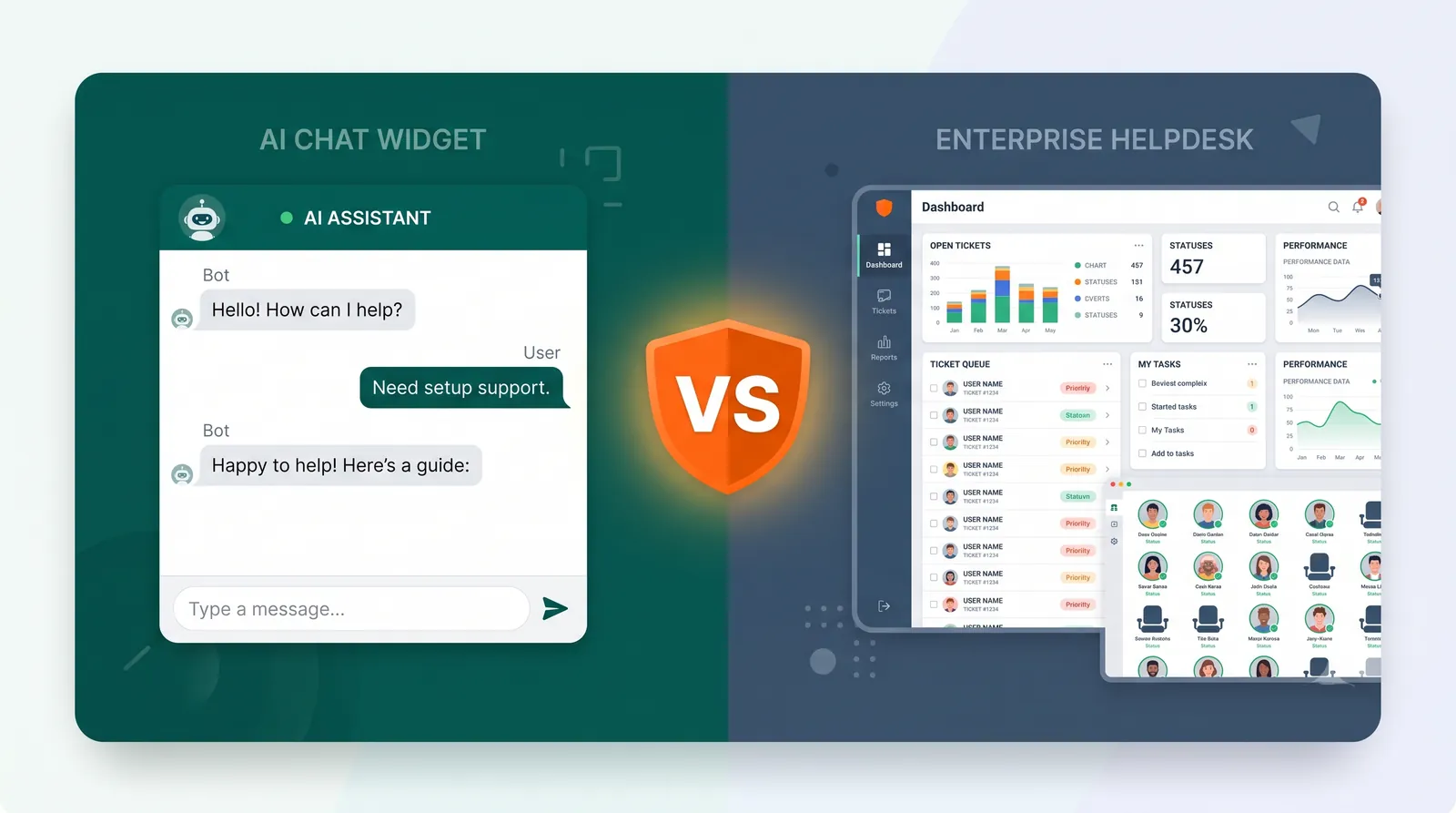
If you're choosing between ChatMox and Intercom, the honest short version is this: Intercom is a full enterprise helpdesk platform with an AI agent bolted on, priced per seat plus per-resolution. ChatMox is an AI-first support widget built to get a trained bot live on your site in minutes, priced flat and predictably. Which one wins depends entirely on what you're actually trying to do.
At a glance
| ChatMox | Intercom | |
|---|---|---|
| Core product | Focused AI support widget + live chat | Full helpdesk suite (inbox, tours, tickets) + Fin AI Agent |
| Pricing model | Flat monthly plans, free-forever tier | Per-seat plans (Essential / Advanced / Expert) + $0.99 per AI outcome |
| Setup time | Single script tag, minutes | Multi-step: inbox setup, seat assignment, Fin configuration |
| AI training source | Crawls your website + knowledge base automatically | Requires content sync into Fin knowledge sources |
| Human handoff | Built in on the Growth plan | Included, but tuned around seat-based agent inboxes |
| Best for | SMBs and solo founders who want a bot live today | Mid-market / enterprise teams already running a multi-agent helpdesk |
Pricing: flat plans vs seats + pay-per-outcome
This is the biggest structural difference between the two products. Intercom sells access in per-seat tiers — Essential, Advanced, and Expert — and layers its Fin AI Agent on top as a metered add-on: $0.99 per resolution, procedure handoff, or disqualification, and $9.99 per qualified lead, with a 50-outcome monthly minimum charged regardless of usage. That model scales well for a support org that already has a large human team and wants AI as a force-multiplier, but the final bill is hard to predict up front because it moves with both seat count and conversation volume.
ChatMox takes the opposite approach: flat monthly plans with a free-forever tier and no per-seat tax. You're not charged per resolution, and adding teammates to handle handoffs doesn't multiply your bill. The trade-off is that ChatMox's plans are usage-tiered (message volume, agents, knowledge base size) rather than infinitely metered — which most small and mid-sized teams find easier to budget against than a per-outcome invoice that changes every month.
Rule of thumb
If your team already lives in a multi-seat helpdesk and treats AI as a triage layer on top, Intercom's model can work in your favor. If you want one predictable line-item and don't want to think about per-resolution math, ChatMox's flat pricing is the simpler bet. Check live numbers on our /pricing page and Intercom's own pricing page before deciding — both change plans periodically.
Time to first working bot
Intercom is a platform, and it sets up like one: you configure a shared inbox, assign seats, decide on workflows, and then point Fin at your content sources before it can answer anything useful. That's reasonable for a team building a permanent support operation, but it's a lot of surface area if you just want a bot answering questions on your site this afternoon.
ChatMox is built around a single goal: paste a script tag, and the bot crawls your site and knowledge base to start answering immediately. There's no seat provisioning step required to get a working AI agent live — you add human teammates later, only if and when you need handoff.
The AI agent itself
- Both products train their AI on your existing content — help center articles, docs, and website pages.
- Intercom's Fin is built to operate across many source systems (Salesforce, HubSpot, Zendesk, etc.) as a layer on top of an existing helpdesk, which matters if you run a heterogeneous support stack.
- ChatMox trains directly from your website and a purpose-built knowledge base editor, then routes to a human the moment it can't answer confidently — with human handoff on the Growth plan, priced per plan rather than per seat.
- Neither is "smarter" in the abstract — the right choice depends on whether your AI needs to sit on top of an existing multi-tool stack (Intercom) or be the whole stack (ChatMox).
Who should actually pick which
| Choose ChatMox if… | Choose Intercom if… |
|---|---|
| You want a bot live today without a implementation project | You already run Salesforce/HubSpot/Zendesk and want AI layered on top |
| You want one flat, predictable monthly price | You're comfortable with per-seat + per-outcome billing |
| You're a small team or solo founder | You're a mid-market or enterprise team with a dedicated support org |
| You want the AI, live chat, bookings, and handoff in one lightweight widget | You need a full ticketing system, product tours, and multi-brand support in one suite |
"Pick the platform that matches the size of the problem you actually have — not the one with the longest feature list."
Frequently asked questions
- Can I switch from Intercom to ChatMox? Yes — export your help center content and re-import it into ChatMox's knowledge base; most teams are live within an afternoon.
- Does ChatMox charge per AI resolution like Intercom's Fin? No — ChatMox plans are flat, not metered per outcome.
- Is there a free tier? ChatMox has a free-forever plan. Intercom requires at least one paid seat.
See ChatMox's flat pricing for yourself
No seats, no per-resolution math — just a plan that fits your team, free to start.
View pricing